News Story
For Dvořák, Serenade for Strings came at a critical moment in his life.
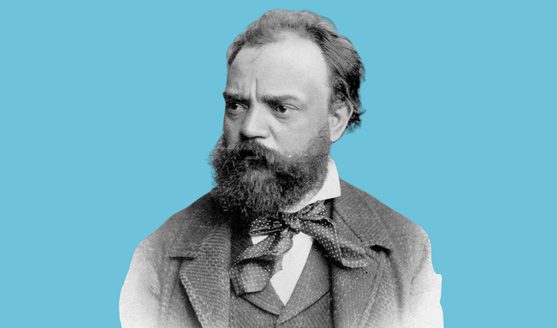
In 1875, Antonín Dvořák was not yet the composer we love today. Symphony No. 9 “From the New World”, one of the landmarks of 19th-century orchestral writing, was still almost two decades away. Even to Johannes Brahms and Joseph Joachim, who would later become his greatest champions, he was simply a name attached to some compositions that had won an award. Until 1874, he had lodged in a house with five other men. He did not even own a piano.
The Serenade for Strings arrived at a decisive moment. Dvořák had just received an Austrian State Stipendium in Vienna, allowing him to compose not only the Serenade, but also Symphony No. 5, String Quintet No. 2, Piano Trio No. 1, the opera Vanda, and the Moravian Duets. Composed in just two weeks, it reveals not only his growing sense of expression and form, but also the full range of Dvořák the young man: bullish enthusiasm, theatrical intensity and a dry wit that both endeared and hindered him to those he met. It’s no wonder Brahms admired him so deeply.
Nowhere is this more apparent than in the work’s opening. A light and breezy cantabile melody, it reflects Dvořák’s attraction to the serenade form: less demanding than the symphony, yet perfectly suited to pleasure, warmth, and entertainment.
The second movement’s waltz soon takes a menacing turn into the minor before an almost Jekyll-and-Hyde-like shift into a Mixolydian E Major. The pièce de résistance is a leap into D-flat Major for an unnervingly brisk development before sweeping back into the diabolical minor, only to resolve unexpectedly into the major again at its conclusion.
The third movement is far lighter: a joyous scherzo that ascends to dizzying heights in the violins and violas, while the cello and bass act like musical guide ropes beneath them. It is a unique and powerful sound, an amalgamation of the deep sincerity of Beethoven, Brahms, and his idol Bedřich Smetana with an unstoppably warm, earthy energy. Here is a composer so eager to prove his worth that even his music seems to trip and skip over itself, racing up and down the instruments with intrepid speed.
And then comes the larghetto, and all pretence drops away. It reveals a romantic side hiding behind an anxious, excitable, earthy force of nature. Its flowing melodies and tender phrases become the bridge between the electricity of the scherzo and the exuberance of the finale, while echoes of earlier themes quietly bind the work together.
That energy carries directly into the finale, where the young Dvořák’s writing becomes truly electrifying. Violins, violas, cellos, and basses surge together in the tutti sections, each vying for control of the melody and conveying the spirit of a Bohemian village dance. The principal theme’s descending sweep is offbeat and stomping before the violins and cellos trade jabs over running quavers in the violas. Ambitiously, a third theme of semi-quavers appears before we learn the true scale of Dvořák’s plans, as he draws together themes from earlier movements into a singular, unified sound. What strikes the listener most is that this is a brilliant showcase of the composer who would emerge in the years that followed: the true beginning of his musical journey.
It seemed fitting, then, that this piece should accompany the beginning of our own young musicians’ journeys.
That an impoverished jobbing organist would, twenty years later, become both a hero of the Czech people and one of the most influential composers of his generation is remarkable. Wherever life leads our pupils, we hope they will be inspired to pursue their own ambitions with similar courage and imagination.
Hear the full piece in our Summer Festival Finale: Summer Serenade on the 3 July 7.30pm.
Related items

Meet the Musicians: Claire Martin OBE and Martin Sjöstedt on the modern jazz scene
21 September 2026Claire Martin has established herself as a tour de force on the UK jazz scene, gaining many awards, including winning the British Jazz Awards as Best Vocalist…
Meet the Musician: Llŷr Williams on Childhood, Liszt and ‘The Most Tuneful Ballet of All Time’
3 September 2026Welsh pianist Llŷr Williams is widely admired for his profound musical intelligence and for the expressive and communicative nature of his interpretations. He…
Menuhin Recommends... Romeo and Juliet by Sergei Prokofiev
14 August 2026‘Two households, both alike in dignity...’ There are few pieces of music that can make a concert hall feel simultaneously enormous and intimate. Prokofiev’s…